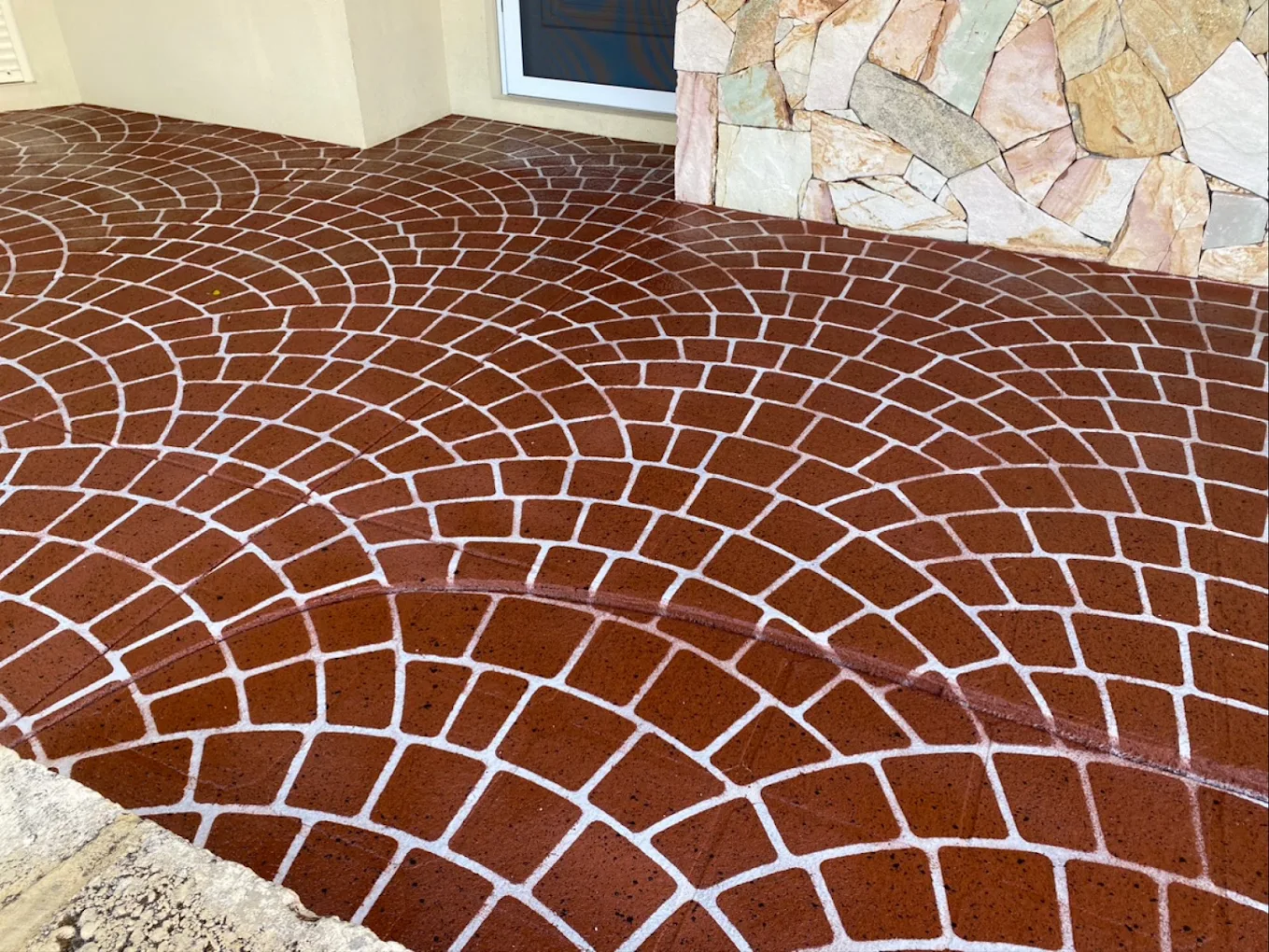
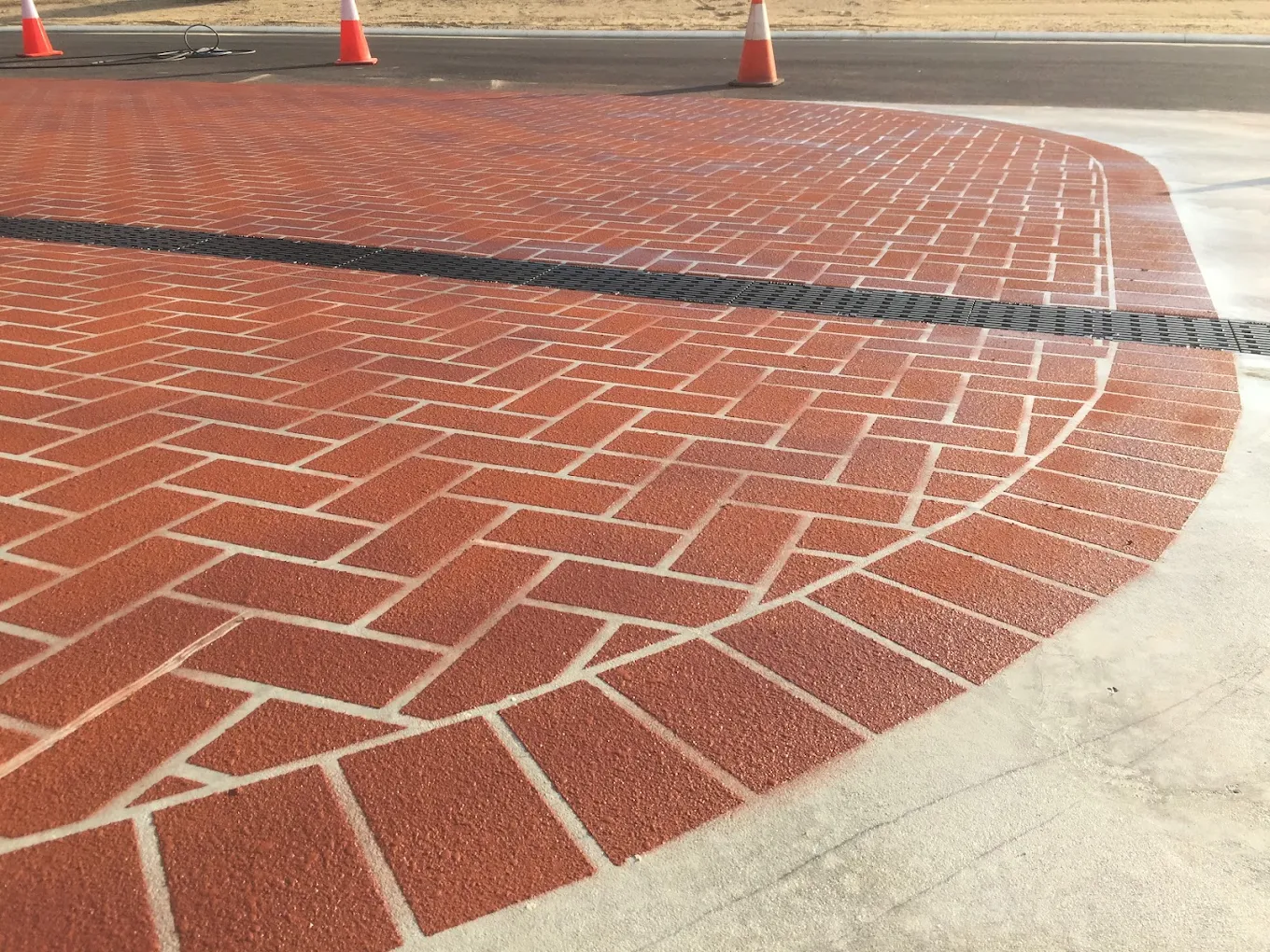
Terracotta herringbone spray-on paving with a curved border edge beside plain concrete
The short answer
Yes, in some cases - but only where the paved area is stable, well drained and not moving. Individual pavers rock, settle and expand independently of each other, so an overlay laid across the joints can crack along them. Where the pavers are firmly bedded and sound, the joints are filled and the surface is properly prepared, an overlay works well. Where the base has failed, it will not.
This is the single most common technical question we get, and the internet answers it badly in both directions. Here is the reality.
Key takeaways
- Stable, well-bedded pavers: overlay is often viable.
- Rocking, sunken or sand-set pavers: fix the base first.
- Joints must be filled and the whole surface mechanically prepared.
- Expect joint lines to remain faintly visible in some conditions.
Why it is a problem
An overlay is a continuous, rigid skin. Pavers are individual units on a sand or road-base bed, and they move - independently, seasonally, and under vehicle load.
Spray a continuous skin over units that move separately and the skin cracks along every joint. That is not a product failure; it is physics.
When it can work
- The pavers are laid on a stable concrete base rather than sand
- There is no rocking, dishing or settlement anywhere in the area
- Joints are tight and can be filled and stabilised
- The area is pedestrian rather than vehicle traffic
The preparation that makes the difference
Where the assessment passes, the process is not a straight spray. Joints are cleaned and filled, the whole area is stabilised, and a bonded base coat goes on before any decorative work. That base coat is what converts many small units into one surface.
Skipping that step is exactly why people have seen bad examples of this job.
The honest alternative
Where pavers are on sand and moving, the durable answer is to lift them and pour a slab, then resurface. That costs more up front and lasts. We will tell you this on site rather than take the job and hope.
If you are weighing the options, our comparison of spray pave, pavers and stamped concrete covers the economics.
The on-site test we run before saying yes
- Walk the area and load each suspect paver - any rocking means no
- Check for sunken sections, ponding water and lifted edges
- Check edge restraints are intact so the field cannot spread
- Confirm drainage falls still run away from the building
- Test-lift a paver in an unobtrusive spot to see the bedding
What preparation over pavers involves
It is more work than overlaying a slab. Joints are cleaned and packed, the surface is ground or acid-free etched to remove sealers and efflorescence, loose units are re-bedded, and a bonding primer goes down before the overlay.
The alternative for a badly settled area is to lift and relay the pavers first, or pour a thin bonded slab over them - both add cost, and we will tell you which one your site needs.
Better candidates than pavers
If you are choosing between areas to resurface, poured concrete is always the better substrate. Our spray-on concrete page explains what an ideal slab looks like.
Frequently asked questions
- Can you spray over brick pavers on a driveway?
- Sometimes. Driveways carry vehicle loads, so the paver field must be firmly bedded with intact edge restraints. If any unit rocks under load, we recommend relaying first.
- Will the paver joints show through the new surface?
- They can, faintly, especially in raking light or after a long hot spell. Filling the joints properly and choosing a patterned rather than plain finish reduces how noticeable it is.
- Is it cheaper than lifting the pavers?
- Generally yes, because there is no excavation or disposal. But it is dearer than overlaying plain concrete because of the extra joint and bond preparation.
- How do I know if my pavers are stable enough?
- We assess on site: load testing suspect units, checking for ponding and settlement, and inspecting the edge restraints. If it is marginal we will say so rather than coat it.