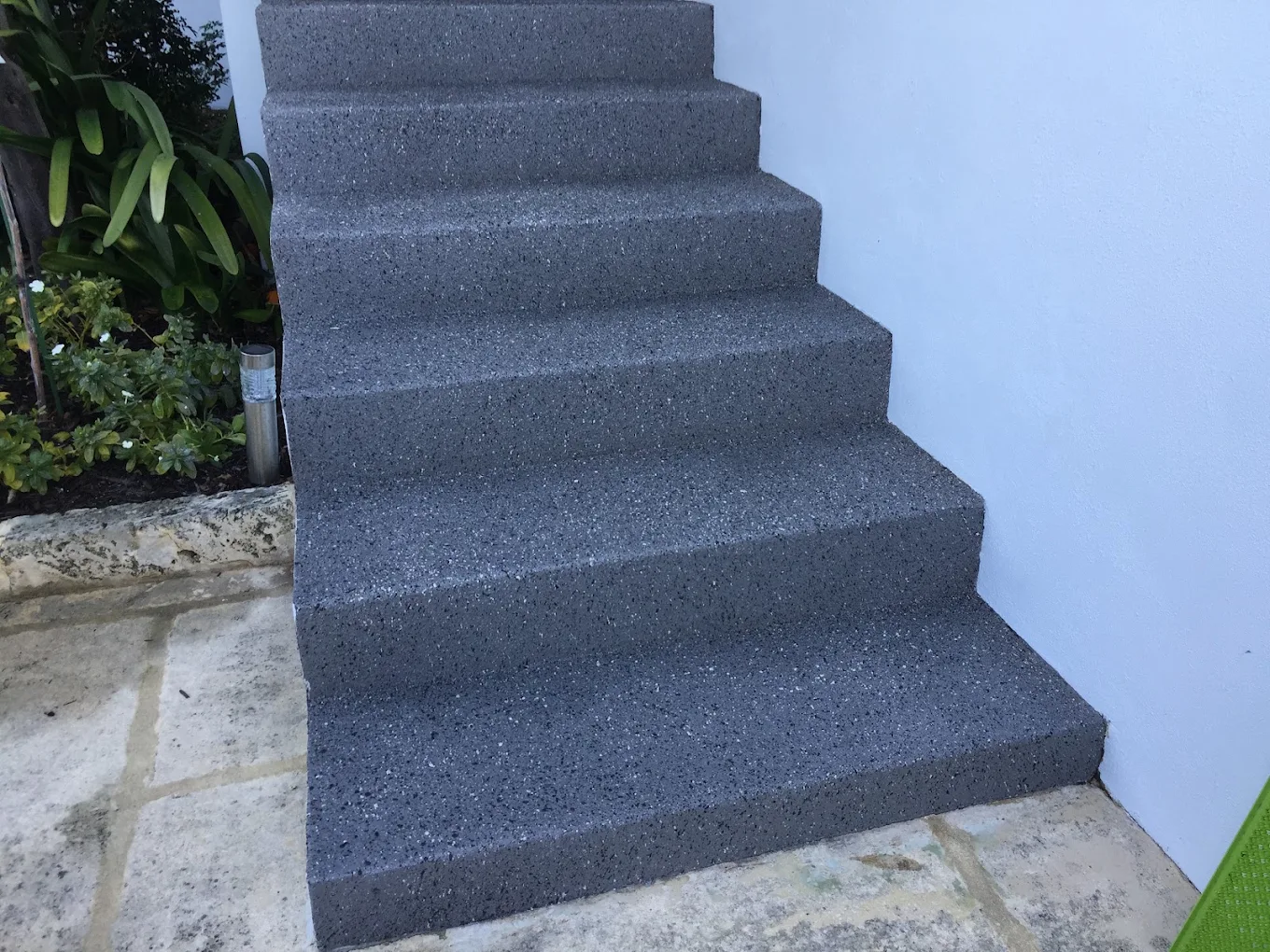
Charcoal speckled coating applied to outdoor concrete steps beside a garden bed
The short answer
A pool surround needs a surface that stays grippy when wet and barefoot. We achieve that with a textured finish plus a fine non-slip additive broadcast through the topcoat, applied to the whole wet zone including steps and the coping edge. Pale colours also matter in Perth: a dark concourse can get too hot to walk on in summer, which drives people onto the wet edge in a hurry.
Pool surrounds are the most safety-critical surface we finish. They are used wet, barefoot, at speed, by children. The finish specification should reflect that, and in many projects a certifier, builder or insurer will ask for evidence of it.
Key takeaways
- Grip comes from surface texture plus a non-slip additive in the topcoat.
- Apply grip to the full wet zone, not just the pool edge.
- Pale bases run cooler underfoot than dark ones.
- Slip resistance is tested wet and barefoot, not dry with shoes.
How slip resistance is measured
In Australia, pedestrian surface slip resistance is classified under AS 4586, using wet pendulum and oil-wet ramp test methods. Results are expressed as classifications - P ratings from the pendulum test, R ratings from the ramp test.
Handbook guidance (HB 198) then maps those classifications to applications. Pool concourses and wet barefoot areas sit at the demanding end.
What that means practically
Classification belongs to a tested system, not to a generic phrase like 'non-slip added'. If your builder or certifier has nominated a classification, give us the requirement and we will specify a sealer system and additive intended to meet it.
Where there is no formal requirement - most private renovations - the practical target is simple: grippy wet, comfortable barefoot, cleanable.
What to ask your contractor
- Which sealer product and which non-slip additive, by name
- What grade and what loading rate per litre
- Whether the additive goes in the final coat and is back-rolled evenly
- Whether a sample panel can be applied and walked on wet before committing
Colour, heat and safety together
A safe pool surround is also one people will actually use. Pale tones stay dramatically cooler underfoot in a Perth February, which matters as much as grip on the day. See pool surrounds and non-slip coatings.
Maintaining grip
Grip lives in the sealer, so it wears with the sealer. Renew on the normal three to five year cycle, and clean sunscreen and body oils off periodically - they are the main cause of a surface feeling slick well before its time.
Specifying grip properly
- Textured or aggregate-look base finish rather than smooth plain colour
- Fine non-slip additive broadcast through the topcoat, not just mixed in
- Grip continued over steps, ramps and the transition to the alfresco
- Matte or satin sheen so wet reflection does not hide step edges
Heat, colour and how families actually use a pool
Surface temperature is the underrated safety factor. When a dark concourse is too hot underfoot, people run across it - and running is what turns a wet surface into an incident. Moving to a pale sand, bone or limestone base is the simplest fix available.
Chemistry and maintenance
Chlorine and salt-cell splash-out attack sealer over time, so pool concourses are sealed with that in mind and re-sealed on a shorter cycle than a covered alfresco. Rinse splash-out zones with fresh water occasionally and never clean the surface with acid.
Regulatory point worth stating plainly: pool barrier and fencing rules in Western Australia are set by your local government and the Building Code, and they are separate from surface finish. Check barrier requirements with your local council before any pool-area works.
Frequently asked questions
- Is spray-on paving slippery around a pool?
- Not when specified for the job. A textured finish with non-slip broadcast through the topcoat gives good wet, barefoot grip. A smooth high-gloss seal around a pool is the combination to avoid.
- What colour is best for a Perth pool surround?
- Pale sand, bone and limestone tones. They stay noticeably cooler underfoot through summer than charcoal or bare grey concrete.
- Does non-slip make the surface rough on bare feet?
- A fine-grade additive gives grip without being abrasive. Coarse grades belong on ramps and commercial areas, not on a family pool concourse.
- Does resurfacing affect my pool fence compliance?
- Surface finish and pool barrier compliance are separate matters. Barrier rules are set by your local government and the Building Code - confirm them with your council before works begin.