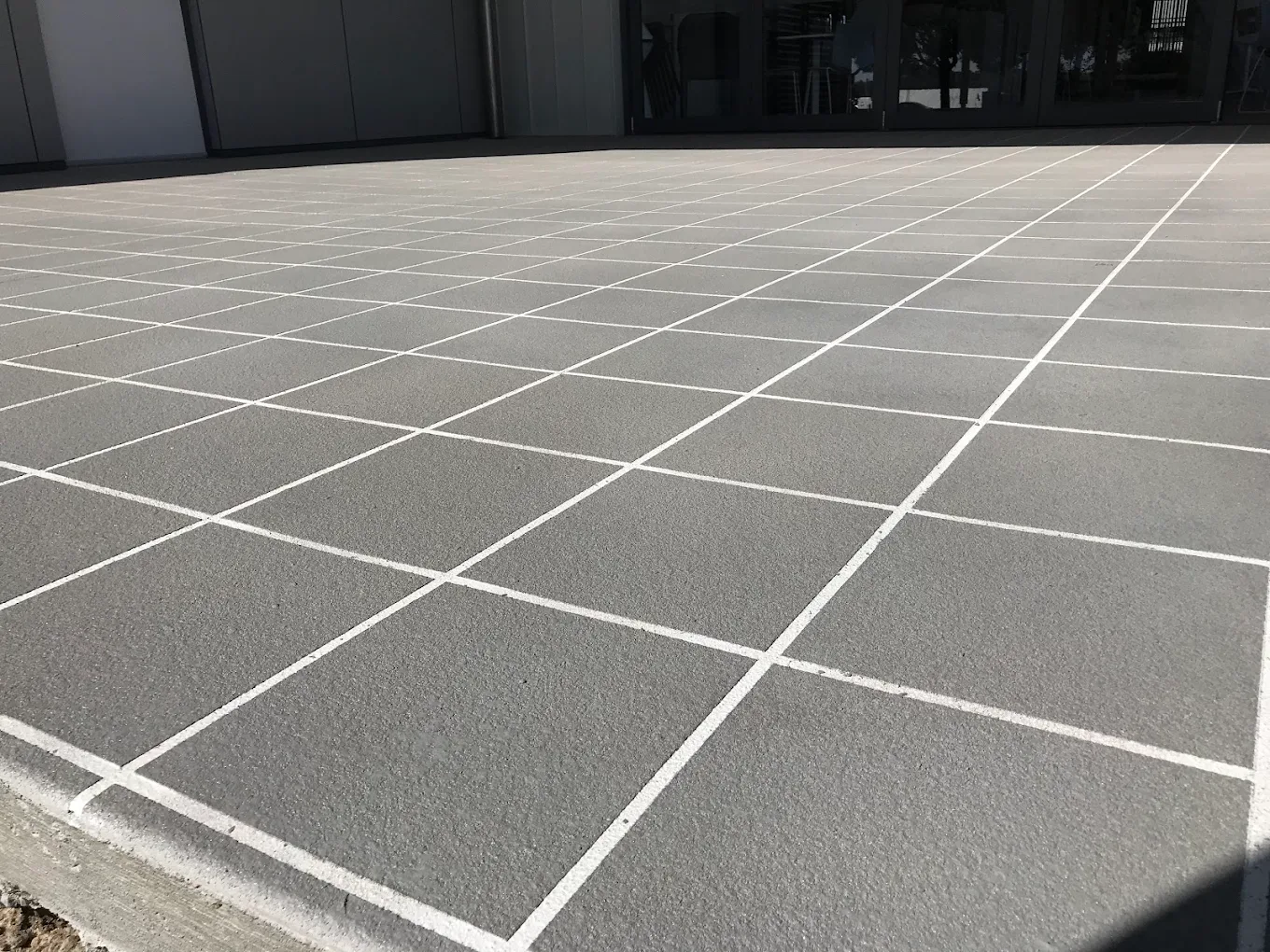
Grey stencil concrete in a large square tile pattern with white joint lines outside a building
The short answer
Resurface when the problems are cosmetic: fading, staining, surface scaling, dusting, hairline crazing, patchwork sections from staged pours, or a failing older coating. Do not resurface when the problems are structural: slabs that rock under a car, stepped or widening cracks, sections that have dropped, or ponding water that points to a failed base. An overlay fixes appearance and surface durability, not foundations.
Concrete gives plenty of warning before it becomes a problem. Reading it correctly saves money, because the cheap intervention and the expensive one are separated by about two years of neglect.
Key takeaways
- Cosmetic problems: resurfacing is the right and cheapest answer.
- Movement, stepping or rocking: fix the base before any coating.
- Ponding water often signals settlement, not just a lazy fall.
- A failing old coating must be ground off, not coated over.
Signs resurfacing will fix
- Colour has faded flat and the surface looks chalky when dry
- Water no longer beads - the sealer has worn through
- Hairline map cracking across the surface with no level change
- Oil and tyre marks that no longer clean off
- Sprinkler mineral staining or rust marks
- Mismatched grey patches where sections were poured at different times
- Moss or algae on shaded side paths
- Surface dusting that tracks into the house
Signs that mean stop
Three symptoms indicate a structural problem that resurfacing will not solve and will not hide for long.
- A level difference across a crack - one side sits higher than the other
- Sections that rock or move underfoot or under a vehicle
- Voids or washouts visible at the edges, often near downpipes or verge drainage
The middle ground
Spalling - where the top few millimetres flake away - can go either way. Localised spalling is repaired during preparation. Widespread spalling across the whole slab usually means the concrete itself is deteriorating and needs assessing before any decorative work.
What to do next
If everything you can see is on the first list, you are looking at a straightforward driveway resurfacing or a re-seal. If anything from the second list applies, get it assessed before spending on any surface finish. Send us photos and we will tell you which one you have.
Seven signs it is time
- The surface no longer beads water - the sealer is gone
- Colour has faded unevenly, worst in the sun-facing strip
- Oil and rust stains no longer wash out
- The surface dusts or sheds fine grit when swept
- Hairline crazing across the top layer
- Obvious patchwork between differently aged pours
- An old coating is flaking, blistering or peeling at the edges
Four signs to fix the slab first
- The slab moves or rocks when a car drives over it
- Cracks that have stepped, so one side sits higher than the other
- Cracks that keep widening season to season
- Water ponding in a spot that used to drain
A five-minute self check
Hose a section and watch it: beading means the sealer is alive, soaking in means it is due. Then walk the slab looking along it at a low angle - dips and stepping are far easier to see from a metre off the ground than standing over them.
If it is cosmetic, book a measured quote and we will confirm the substrate before recommending a system. Compare the options first in spray pave vs pavers vs stamped concrete.
Frequently asked questions
- Can you resurface a cracked driveway?
- Hairline and non-moving cracks are chased out, filled and covered. Cracks that are stepped, widening or caused by movement need the underlying problem fixed first, otherwise they will reappear through the new surface.
- How do I know if my sealer has worn out?
- Hose a small area. If the water beads and sits, the sealer is intact. If it soaks in and darkens the concrete, a re-seal is due.
- My old coating is peeling. Can you spray over it?
- No. Any failing coating must be mechanically ground off first - coating over it simply transfers the failure to the new surface.
- Is resurfacing worth it before selling?
- It is one of the highest-impact presentation changes available in under a week, since the driveway is usually the largest single surface a buyer sees from the street.